One of the best things that ever happened to my teaching was Paragraph a Week (PaW). This simple weekly writing program provided a framework for building student fluency in writing, reinforced the writing process, and established a homework routine. Although my students mumbled and grumbled each week as I passed out the topic instruction sheets, they also could see improvements in their written compositions. I can't tell you how many students that I have seen in the past few years who have commented about Paragraph a Week, stating that it really helped them learn how to write. What more can a teacher want?
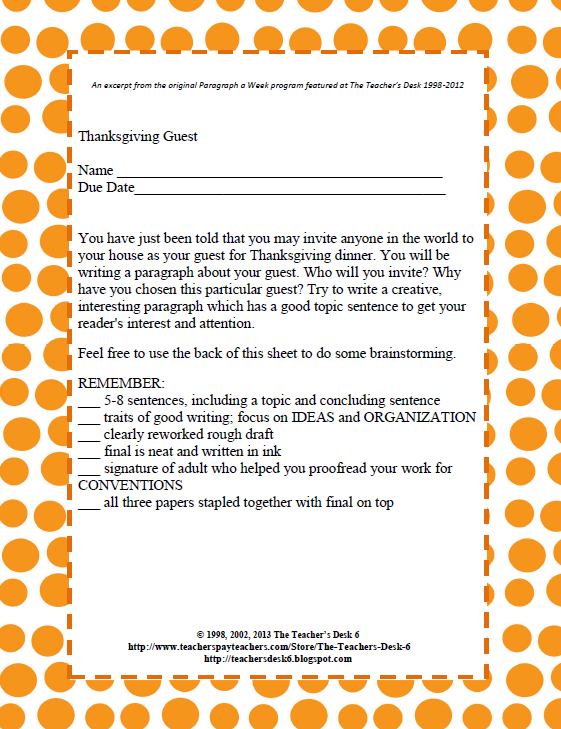
You can download this week's FREEBIE PaW topic instruction sheet HERE just in time for the upcoming Thanksgiving holiday.
One of the best technology "things" that I've stumbled upon in the past few years is a video processing site called Animoto. If you have not seen this website I encourage you to hop on over and check it out. It allows the user to create 30 second video slideshows featuring original photos and/or downloaded pics from the internet. Paid subscription accounts are also available, but Animoto does a great service for educators. Teachers can apply for FREEBIE educational accounts for themselves and their students that allow them to develop videos of longer length. Education accounts are similar to a paid account with a few very minor exception. The one drawback to the educational account is that it expires at the end of six months. Teachers can renew their accounts and their student accounts but it is a bit of a process. My suggestion to Animoto is that they increase the length of the account to one year, or at the least nine months.
One of the first videos that I created is this brief one that I used with my fifth grade class last year as we were delving into Newbery Literature. I have a great poster that features all of the Newbery award winning books from the inception of the award through 2012, but I wanted a video to capture the attention of my fivers. They loved music and singing and all things technology. Animoto was the perfect tool for me to whip up a quick video to accompany my lessons. This was playing when they entered the room. They LOVED it! If I recall I think I played it four or five times before I could go on with the lesson.
Animoto is exceptionally easy to use. Animoto provides an instructional video but I chose to skip it since I found the site quite intuitive. Additionally, there are several good tutorials on YouTube for anyone who likes step-by-step instructions. Just use any internet search engine to locate them or go directly to YouTube to search.
Animoto's interface is user friendly and works similarly to a typical word processing program. To begin a project you select a template. Depending on the type of account you have will depend on the kind of template that you may select. Free accounts have far fewer choices and fewer privileges, however, stunning videos can still be created. The next step requires the selection of photos, either from Animoto's vast onsite collection or by uploading your own. Snippets of videos can even be added if there is enough time available in your project (this is where it is advantageous to have an education account). Each template has a pre-selected audio file. This, too, can be changed. You may select from Animoto's list of musical pieces (a rather limited database) or once again, your own. Finally, you can tweak your video using a few special effects, the variety and number vary with the type of account you are using, and then produce it.
Your video can be shared on social media site, such as FaceBook, with the click of a button or embedded in blogs and websites with HTML code. Individual video links can even be shared via email by copying and pasting the web address. Education and paid account users can even download their videos for playback on PC's and handheld devices.
The following three Animoto videos were completed as an assignment by sixth graders. The class had been reading realistic/historical fiction centered on the Holocaust. We had spent time learning and researching actual historical evidence (newsreel videos, history texts, personal memoirs, et al.) and comparing this with the fictional text in The Devil's Arithmetic by Jane Yolen. My sixers could select from several methods of presenting what they learned: an Animoto video, a powerpoint presentation, or a Social Media book response (something I developed and is available for purchase in my TpT Store and Teacher's Notebook Shop). This assignment was very open-ended. I really was interested in seeing what my kiddos would do without strict parameters. I had spent the year developing these types of projects with them, giving specific directions and instructions. They had made Animoto videos before, had watched me use and demonstrate PowerPoint, and the Social Media book responses were patterned after Pinterest, FaceBook, and Muzy, all sites I used with them on a weekly basis.
Needless to say, I was quite pleased with what they had produced. The only complaint I have is that some took an improper shortcut to their image citations, simply stating they got their images from Google, even after I had talked and talked about this over and over, off and on, all year... get my frustration? I would've required those who had taken this shortcut to make corrections, but their accounts had expired on Sunday, May 5th... thus my suggestion to Animoto as I mentioned above.
If you are interested in using Animoto with your students you might be interested in seeing a few of the items that I use with my sixers as I first begin teaching them about making videos. The first project that they do is making a book trailer, patterned after a Hollywood film trailer. You can download the instruction sheet HERE and the assessment tool to accompany the project HERE or by clicking on the individual graphics. These items might provide some help for you as you begin developing video projects with your students.
Do any of you use Animoto? What are some ways that you use it with your class? Do you use any other video websites? I'd love to hear from you!
I am crazy about Pinterest!!! It's gotten to the point that both my fifth and sixth graders will ask if the idea I am sharing with them came from Pinterest. I'm crazy to the extent that I've begun creating some "worksheets" featuring Pinterest boards.
Here's one I just finished that is a book report. It's actually part of a set of Social Media Book Reports that I'm offering in my TpT Store and Teacher's Notebook Shop. The complete set of book reports contains not only the Pinterest design, but also designs for an iPod, Facebook, and Muzy. My sixers have really liked doing these reports. They are just as crazy about social media as I am, maybe more... NAH!
You can download the Pinterest FREEBIE HERE or by clicking on the graphic.
Here are just a few things I've been pinning this week. It's a little bit of this and a little bit of that...
Happy Pinteresting,
Happy Teaching,
Angela
The Teacher's Desk 6
During the month of April my sixers and I have been reading, writing, and ENJOYING poetry! What began as groans after Spring break has turned into eager cries of "What kind of poem are we gonna do today, Ms. A.?"
So far we've enjoyed highly formalized poems such as haiku, tanka, and diamonte; explored rhyme scheme with couplets, quatrains, limericks, and clerihew; and giggled, laughed, and been left speechless by free verse and dada. "What is dada?" you say. Hmmm? Better than I trying to explain this most unusual poetry format, try your hand at a dada poem here:
A poem similar to dada is a Page Poem. I had never seen this type of poetry until I stumbled upon it on Pinterest. Pinterest? Ah, what would I do without Pinterest? Here's what I pinned about Page Poetry.
I absolutely fell in LOVE with Page Poetry. Crazy and deviant as dada, Page Poetry calls for great visual creativity, not something added as an after thought, but art that is essential to the meaning (if you can call it that) of the poem. Some Page Poems appeared to be random ramblings of strange, twisted minds while others appeared well thought out and planned. I can do this, I thought! My sixers can do this! And so they did and with great fun, great thought, great sharing, and great discussion.
I introduced Page Poetry to my sixers by sharing my Pinterest Pins and visiting some of the websites. Fresh from creating dada poems, they were hooked and couldn't wait to begin. Next we began looking through our library for a book that might lend itself to creativity and fun. It also had to be a book that was well loved, meaning it was ready to fall apart. We hit the jackpot with an old copy of one of the Mrs. Piggle Wiggle books. With some sadness at having to destroy the book, I ceremoniously began tearing out pages at random and passing them to my sixers with great dramatic flair. From there my sixers spent quite some time reading and rereading their given page, searching for just the right words.
Once the words were chosen, they had to decide how to present their poems, how elaborate would the page appear? Some simply used black pens to circle the words and draw directional lines, some added color, others added textured lines, while others utilized multiple colors, shapes, and designs.
These are just a very few of the Page Poems created by my students. Enjoy!
Last month I created a Parts of Speech Round-up for my sixth graders during which they participated in six different activities (six learning stations) to help them practice the parts of speech. You can read about it HERE. They LOVED it and asked to do it again! Anytime sixth graders beg to do parts of speech you know you've got a hit on your hands.
Keeping the idea of a round-up in mind, I decided to do something similar with poetry since April is entitled Poetry Month (roundups are so adaptable and easy to put together), and I have my annual observation on Tuesday of this week. Guess what day I have the roundup scheduled?
Here's what I have planned:
Activities and Objectives
Poetry Spinner: Students will select from a choice of three
poems, read, and analyze the poem for particular literary elements, among them
mood, theme, and figurative language.
Roll the Dice Poem: Students will compose
a free verse poem based upon the roll of dice; the total number of dots per
roll indicates the number of syllables per line.
Wordsearch: Students will recognize poetry forms as being
rhyming or non-rhyming while solving a wordsearch puzzle.
Bio Poem: Students will complete two graphic
organizers which in turn will aid them in composing an autobiographical poem
Holiday or Color Poem: Using an online
poetry generator, students will choose one of two formats to complete. They
will print out their poem and add color and illustrations to create visual imagery
to accompany the verbal imagery.
DaDa: Students will compose a DaDa poem.
This is a paper that provides more detail about each activity or station. Included are CCSS ELA for Sixth Grade, student directions, as well as where the station ideas came from (a shout out goes to Rachel Lynette, Laura Candler, Instant Poetry Forms Online, and the Classroom Game Nook). You can download a copy HERE.
Also available for use is a set of learning targets based upon the gr. 6 CCSS ELA. I made these to place near each station. I've always stated lesson objectives prior to instruction, but I'm trying to be more concrete/obvious with these so that students become more aware of their exact role in the learning process. I printed each target as needed (one is used three times) on card stock and folded each paper in half so that it stands like a tent. You can grab a copy of these desk plates HERE.
I am REALLY looking forward to Tuesday, even though it is Observation Day! I'm also looking forward to a new feature at Teach Junkie: Teaching Idea Tuesday. I thought my Roundup idea would be a good starter for this brand new linky.
Besides being a teacher, I am a musician and singer. I constantly have music floating through my head and I generally walk to a beat. As a result I have always tried to include music in my teaching. Setting facts and concepts to a familiar tune and teaching it to children results in a quicker and longer retention rate of material. It does take a bit of time to set your instructional content to music, but with the advent of YouTube it is easy to locate a piece of music for just about any concept that you must teach. Just ask the parents of my current sixth grade class.
I had the pleasure of working with this group of students when they were in fourth grade, teaching them Science. I introduced the concept of the periodic table and its features to them during a unit on "Kitchen Chemistry." Pretty heavy stuff for fourth graders! However, knowing that these children LOVED to sing, I went in search of some music about this concept. I found a few gems on YouTube that were suitable for this age group and shared them with the class. One turned out to be quite a treasure! They beg me to let them sing it TO THIS DAY (two years later) and they have gone on to write additional verses. Nearly every one of my current sixth graders is able to recite AT LEAST the first 20 elements in the periodic table thanks to this video.
With that being said, I am pulling out an old, old song I used years ago in my Language Arts classes, one to help my students learn the purpose of each of the eight Parts of Speech. It's been hidden in a drawer of my desk, collecting dust far too long. It served my students well at one time, and since my class this year LOVES to sing, it's time to air it out once again. It was developed by me and a few staff members who were attending an afterschool inservice about multiple intelligences and thematic planning (hint as to the decade).
Parts of Speech song
Sung to the tune of "Here We Go 'Round the Mulberry Bush"
What are the parts of speech, parts of speech, parts of speech? What are the parts of speech? Listen well and learn! Nouns,verbs and interjections, adverbs, pronouns, prepositions, Conjunctions and adjectives Are the parts of speech. A noun is a naming word, naming word, naming word. A noun is a naming word, a person, place, or thing. A verb is an action word, an action word, an action word. A verb is an action word or am, is, are, was, were. A pronoun renames a noun, renames a noun, renames a noun. A pronoun renames a noun: she, he, it, they, we. An adjective's a describing word, describing word, describing word. An adjective's a describing word; it tells about a noun. An adverb describes a verb, describes a verb, describes a verb. An adverb describes a verb: how, when, where, how much. Interjections shows surprise, show surprise, show surprise. Interjections show surprise. Oh my gosh! Conjunctions are joining words, joining words, joining words. Conjunctions are joining words: and, but, or, for, yet. In, around, about, behind, over, under, up, inside, Into, during, with, before These are prepositions. Now you know the parts of speech, parts of speech, parts of speech. Now you know the parts of speech. You will use them in your writing.
Please feel free to borrow this song and use it with your students. I'd love to hear how the experience goes.
Angela
The Teacher's Desk 6
teachersdesk@yahoo.com


 Besides being a teacher, I am a musician and singer. I constantly have music floating through my head and I generally walk to a beat. As a result I have always tried to include music in my teaching. Setting facts and concepts to a familiar tune and teaching it to children results in a quicker and longer retention rate of material. It does take a bit of time to set your instructional content to music, but with the advent of YouTube it is easy to locate a piece of music for just about any concept that you must teach. Just ask the parents of my current sixth grade class.
