Image Map
Showing posts with label literary elements. Show all posts

April 23, 2013

Poetry Round-up: TEACHING IDEA TUESDAY

Last month I created a Parts of Speech Round-up for my sixth graders during which they participated in six different activities (six learning stations) to help them practice the parts of speech. You can read about it HERE. They LOVED it and asked to do it again! Anytime sixth graders beg to do parts of speech you know you've got a hit on your hands.

Keeping the idea of a round-up in mind, I decided to do something similar with poetry since April is entitled Poetry Month (roundups are so adaptable and easy to put together), and I have my annual observation on Tuesday of this week. Guess what day I have the roundup scheduled?

Here's what I have planned:


Activities and Objectives

Poetry Spinner:  Students will select from a choice of three poems, read, and analyze the poem for particular literary elements, among them mood, theme, and figurative language.

Roll the Dice Poem: Students will compose a free verse poem based upon the roll of dice; the total number of dots per roll indicates the number of syllables per line.

Wordsearch:  Students will recognize poetry forms as being rhyming or non-rhyming while solving a wordsearch puzzle.

Bio Poem: Students will complete two graphic organizers which in turn will aid them in composing an autobiographical poem

Holiday or Color Poem: Using an online poetry generator, students will choose one of two formats to complete. They will print out their poem and add color and illustrations to create visual imagery to accompany the verbal imagery.

DaDa: Students will compose a DaDa poem.


This is a paper that provides more detail about each activity or station. Included are CCSS ELA for Sixth Grade, student directions, as well as where the station ideas came from (a shout out goes to Rachel Lynette, Laura Candler, Instant Poetry Forms Online, and the Classroom Game Nook). You can download a copy HERE


Also available for use is a set of learning targets based upon the gr. 6 CCSS ELA. I made these to place near each station. I've always stated lesson objectives prior to instruction, but I'm trying to be more concrete/obvious with these so that students become more aware of their exact role in the learning process. I printed each target as needed (one is used three times) on card stock and folded each paper in half so that it stands like a tent. You can grab a copy of these desk plates HERE.


You might also like a copy of the poetry wordsearch that is part of the poetry roundup. You can grab a copy HERE.


I am REALLY looking forward to Tuesday, even though it is Observation Day! I'm also looking forward to a new feature at Teach Junkie: Teaching Idea Tuesday. I thought my Roundup idea would be a good starter for this brand new linky.

BTW... my observation went well!

Happy Teaching,
Angela
The Teacher's Desk 6


Teach Junkie Creative Ideas


Classroom Freebies Manic Monday

March 3, 2013

A Novel Idea: Story Chains and a TpT Holiday Offer


I mentioned today’s topic, Story Chains, in my last blog entry Novel Responses to Novels on March 1, 2013. Story Chains is a fun and motivating way for students to demonstrate they have acquired the ability to retell a story, to sequence the actions in a story, to relay the main idea and details of a selection, or to summarize the plot of a chapter or book. 

I have used this activity with my fifth- and sixth-grade students who have read both fiction and nonfiction selections and with eighth-grade Science students who have read textbook material. It could easily be adapted for any grade level and any content area. In addition, it is an activity that works well as a co-operative group activity or as an individual assignment.

Directions:
1.    Assign a story, novel, or text selection for students to read.
2.    Prepare numerous 1" by 8 1/2" white (or pastel-colored) paper strips.
3.    Distribute your determined strips to each student or co-operative group of students.
4.    On one strip, ask students to write the title and author of the selection. If it is a selection from a textbook, have them write the chapter title, page numbers, or any pertinent identification information.
5.    On each of the remaining ten strips, the students should write a sentence or two detailing important events or main ideas from the reading selection. Remind them to include events from the beginning, the middle, and the end of the selection. The chosen events should summarize the selection or identify the main idea and supporting details.
6.    Require the students to include various visual symbols that support the information on each strip as well as page or paragraph numbers where the information is found.
7.    When all the strips are completed, the students are to staple or glue them in an interlocking chain in order, similar to holiday paper chains.
8.    Ask the students to share their chains with the class.
9.    Use the chains to decorate a bulletin board or hang them in the hallway for all the students in your building to enjoy.


As I looked back at this activity that I’ve used almost since I began teaching, I noticed that it aligns nicely with the grs. 5 and 6 ELA Common Core Standards for Literature and Informational Reading. I’m sure it could also be adapted for other grades as well.

Happy Teaching,
Angela
The Teacher’s Desk 6
teachersdesk@yahoo.com


P.S. Did you notice that The Desk is WEARING THE GREEN? Happy St. Patrick's Day!


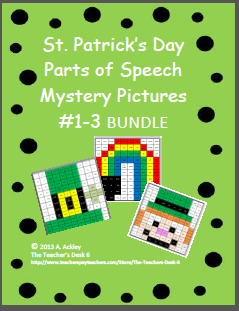
To help celebrate this holiday, I am offering my St. Patrick's Day Parts of Speech Mystery Pictures in a bundle. Each individual picture is priced at $1.00. For the month of March I am offering the bundle of THREE for only $2.00... you get one FREE! Click HERE or on the link below the picture to download your bundle. Erin go bragh!


March 1, 2013

NOVEL Responses to Novels

I've been a Language Arts teacher for a LONG time! I've seen many changes in teaching methods, philosophies, best practices, Common Core, etc., etc., etc. Some of the old becomes new again, and some of the new becomes quite old. What hasn't changed is that a good teaching activity is still a good teaching activity! 

I've been sorting through The Desk lately and have come across many good activities that I've been using since my early days. One file I found was titled NOVEL RESPONSES (one of the first ideas I posted on my original website in 1996). In it are numerous ideas for having students respond to the novels that they read. I still use most of these in either my fifth or sixth grade classes. I'll be sharing many of these novel responses in the coming days.

Here's a sampling with which to begin:

  • Write a letter to one of the characters in the novel. Ask him/her questions as well as tell about yourself. Pay particular attention to letter format.
  • Create a newspaper page for one of the novels. Summarize the plot in one of your articles. Cover the weather in another. Include an editorial and a collection of ads that would be pertinent to the novel.
  • Summarize the plot by creating a cartoon version of the novel. Use about six to eight frames.
  • Rewrite a chapter or section of your novel from another character's point of view.
  • Pretend you are a newspaper reporter whose job is to interview one of the characters. Write your interview.
  • You have become a character in one of the novels. Describe your experience during a conflict.
  • Write a poem about one of the novels. Touch on the characters, setting, plot, and theme.
  • Rewrite a portion of the novel as a play.
  • Choose a familiar melody, such as "Mary Had a Little Lamb," and change the lyrics so they pertain to the novel.
  • Develop a mini matrix for your novel... more about this activity in a later blog post
  • Create a mini story wheel for your novel... more about this activity in a later blog post
  • Create a story chain for your novel that consists of at least ten links... more about this activity in a later blog post
  • Compare and contrast one of your novels with another that you have read for class this year or last. Remember to include how the novels are alike AND how they are different. Create a Venn diagram to show your findings.
  • Redesign the front and back cover of your novel. Include the pertinent information as well as a blurb on the back.
  • Develop an award for your novel. Explain the criteria for the award and why this particular book was selected to receive it. A good place to start this project is by reading about the Newbery and Caldecott awards. Notice, too, the other awards particular books have been given.
  • Create a triorama for your novel that depicts the most important scene. Write a summary of this scene, explaining its role in the storyline.
  • Design a story map for your novel. Include important information such as characters, setting, and the plot. Write a brief explanation of your map.
As I read through the list, it dawned on me that even though these ideas had been posted almost 20 years ago, most of them align nicely with the current Common Core State Standards. Sounds like another project for me to work on!


Happy Teaching,
Angela
The Teacher's Desk 6
teachersdesk@yahoo.com

February 20, 2013

Response Booklets

I recently observed a sixth grade language arts teacher at a different school and liked an activity that she was doing with her classes. I immediately began planning how I could incorporate this same idea into my own classroom. I call the activity a Response Booklet. The first one I'm having my students do is centered around sentences and aligns with the Common Core Standard for English Language Arts grade six number five. It's a great way for my students to brush-up on previously taught skills without them having to complete a worksheet, and it causes them to read more closely and thoughtfully.

I am anxious to see my students' completed booklets and will share photos here when they are finished with them.

 Feel free to download a free copy and try it out in your classroom. Although intended for a sixth grade class, it can easily be adapted to other grade levels. This is the first of several response booklets I have planned. The complete set will be available for purchase in my Teachers Pay Teachers Store when it is finished.

You can download a FREE sample copy HERE.


I hope you enjoy making Response Booklets with your students. I welcome your comments and suggestions.

Angela
The Teacher's Desk 6
teachersdesk@yahoo.com