Image Map
Showing posts with label classroom management. Show all posts

August 8, 2016

Monday Made It

I've been busily working at preparing all those things that are needed in a classroom each year: signs, bulletin board elements, instructional materials, classroom management pieces, etc.


so I think it's time to join Tara over at 4th Grade Frolics for...


I am launching a new theme this year... SCRABBLE! The colors (brown, black, and the primaries) are more in keeping with the classroom I moved into last year. One of the first things that I made was a cursive alphabet pennant banner. Also in this line are a welcome banner and brag tag starter set.


Speaking of brag tags... I've been working on several new sets (a growing bundle of glittery emojis) and one set that I started two years ago, used in my own classes, yet never uploaded to my TpT Store (spelling tags for the entire school year). Here you see my assistants providing suggestions as I create my emoji tags.


I printed out all my tags and signs and ran them through the laminator, while binging on "Penny Dreadful" on Netflix.


Here is the next step in my Made It saga... cutting out EVERYTHING!


The final Made It this week is the punch cards that I use in conjunction with all those brag tags. Punch cards are the means for tracking the targeted behaviors I observe and reward. In this case, homework. For each homework assignment that is competed on time, a student receives a punch on his/her card. Every five punches, a student earns a brag tag, and when the entire card has been punched, a student earns a no homework coupon. My kiddos LOVE no homework!


Be sure to hop over to this week's Monday Made It to see all the terrific things that teacher bloggers have made. I know you'll find something there that you'll just have to make, too!

And if you're reading this and it's still Monday, hop on over to TpT to check out all the #mondaymadness deals being offered. Just search using #mondaymadness to find loads of great deals. Teacher sellers mark down favorite teaching items to one dollar for this day only. If you visit my store, you can pick up FOUR sets of brag tags suitable for bigger kids for just one dollar each. Hurry though, #mondaymadness last only for today, Monday!


January 2, 2016

New Year Incentive for Braggin' about Great Work

"I forgot my homework, Ms. A.!"
"I left my homework at home, Ms. A.!"

Sound all too familiar? Sure was for me, until I started using brag tags as an incentive in my classroom.

So just what are brag tags, you might be thinking? Brag tags are badges/mini-awards that students earn by completing a specified behavior. They are incentives for good behavior, good habits, and good work. Students collect these cute tags and hang them on a metal ring, cord, bracelet, or necklace. They can wear these bracelets and necklaces or hang their rings in a prominent place to display their accomplishments. They get to brag about what they have accomplished, thus the name.

My kiddos LOVE collecting them and can't wait for me to introduce the newest set. No more homework woes, just lots of braggin' about great work and terrific work habits! Please visit my TpT Store to see all the cute tags that I've created for my students. Here's a small sample.


Test drive some brag tags in your classroom with this free set, just in time for the New Year. These just might be the thing to motivate your students to start the year off on the right homework foot. You can download your set HERE.


July 23, 2015

A Thought for Thursday: Rewired

Have you seen this video yet? It really made me think.


This little video demonstrates a vast difference between the current generation of students and those that came before. I've been teaching long enough to have spanned a generation (nearly two) and I readily see the difference, in likes, behavior, modality of learning, etc. and I've also seen how I've had to change my teaching over the years to meet these changing student characteristics.

What has been very interesting to me is that these generational changes are not just of the nuture kind, in other words, learning from the environment or what someone is exposed to. There is actually a nature, or biological change taking place in our students as a result of their exposure to so much technnology, in this shift from active play to constantly stimulated mental play. It's an evolutionary shift of sorts.

An excellent text that discusses this issue and provides advice for dealing with it is titled Rewired: Understanding the iGeneration and the Way They Learn.
Here's what Amazon has to say about this text.
Look around at today's youth and you can see how technology has changed their lives. They lie on their beds and study while listening to mp3 players, texting and chatting online with friends, and reading and posting Facebook messages. How does the new, charged-up, multitasking generation respond to traditional textbooks and lectures? Are we effectively reaching today's technologically advanced youth?Rewired is the first book to help educators and parents teach to this new generation's radically different learning styles and needs. This book will also help parents learn what to expect from their "techie" children concerning school, homework, and even socialization. In short, it is a book that exposes the impact of generational differences on learning while providing strategies for engaging students at school and at home.
I had the opportunity to read this book about four years ago, shortly after it came out, and I remember thinking that Dr. Rosen was on to something. Yet in the hustle and bustle of everyday life and changing school buildings, Rewired's message got a little lost in the shuffle. I remember the gist of the message but not the details. Seeing the Nature Valley video made me think of it, find it on my Kindle, and peruse it once again.

As I'm reading Rewired again, I am struck by the author's description of the current generation of students. He refers to them as multi-taskers by need and not by choice. They MUST be doing several things at once. That's how they are wired, literally! Their brains are wired to do many things at once. However, the depth of their task completion is not that of previous students. Today's students tend to do lots of work and cover lots of material but at a much shallower level than previous generations. The author claims that as a result of being exposed to so much sensory information and stimulation from such an early age, gone are the days in school when students can focus for extended periods of time on one assignment. I am reminded of the old adage... A Jack of all trades but a Master of none! 

The Common Core calls for depth of knowledge, quality of coverage rather than quantity of coverage. Think of those ELA standards that state that a student will read for EXTENDED periods of time or write for EXTENDED periods of time. Uh oh! Time for me to keep reading to see what we educators can do to help our current students succeed! I am fascinated!

Have any of you read this book? Have you read anything else on this topic or similar topics?


I'm adding this post to the Teaching Trio's technology linky. Be sure to stop by their blog to read more posts about technology in the world of teaching.


July 14, 2015

Two for Tuesday: Homework Woes Solution

It's time to join Chalk One Up for the Teacher for some AWESOME bargains...


This week's bargains at The Teacher's Desk 6 are marked 50% off through Thursday, July 16, 2015 and offer you a fun, engaging, classroom-tested method for managing homework. Click on the product links below the graphic to learn more about each product.


Looking for more bargains? Hop on over to Chalk One Up for the Teacher where you're sure to find more great teaching products. Don't wait too long! The bargains only last a little while.


July 13, 2015

Monday Made It: Another kind of TPT

At the beginning of summer I mentioned that I was reading several professional development books, among them Total Participation Techniques (TPT, for short) by Persidea and William Himmele.


One of my BBB's, Lisa from Mrs. Spangler in the Middle, wrote to me and said that she was VERY interested in hearing more about this book and its contents. Lisa inspired me to do this book talk. Thanks for the great idea, Lisa!

About this book...
Providing easy-to-use alternatives to the stand and deliver approach to teaching that causes so many students to tune out--or even drop out--Total Participation Techniques presents dozens of ways to engage K 12 students in active learning and allow them to demonstrate the depth of their knowledge and understanding. The authors, Persida Himmele and William Himmele, explain both the why and the how of Total Participation Techniques (TPTs) as they explore the high cost of student disengagement, place TPTs in the context of higher-order thinking and formative assessments, and demonstrate how to create a TPT-conducive classroom.  
Readers will learn how to implement field-tested techniques they can use on the spot (e.g., Quick-Draws, Quick-Writes, Chalkboard Splash); with Hold-Up cards (e.g., True/Not True, Selected Response); with movement (e.g., Bounce Cards, Line-Ups, Simulations); and to guide note-taking and concept analysis (e.g., Picture Notes, 3-Sentence Wrap-Up, Debate Team Carousel).
Filled with examples from real classrooms, Total Participation Techniques is an essential toolkit for teachers at all levels and for administrators who want a model for analyzing lessons to ensure that they are relevant, engaging, and cognitively challenging... from Amazon.com
As I read through the book, I recognized many things that I already did in my classroom that were TPT's; I just didn't call them that. I've been using exit tickets and quick writes for some time, as well as Pair-Share or Turn and Teach; Thumbs-up, Thumbs-down; and using sign language to indicate multiple choice answers.

What I like about the book is that there is a plethora of activities, MANY more than what I was already familiar with, described IN DETAIL...

Each TPT is presented in four parts:* A descriptive overview * How It Works--step-by-step instructions for implementation* How to Ensure Higher-Order Thinking--ideas for advancing students beyond surface-level thinking* Pause to Apply--suggestions for how to adapt and personalize the technique for specific contexts and content areas... from Amazon.com
Have any of you read this book? I'd love to hear your thoughts about the techniques presented. Has anyone implemented the techniques?


This now brings me to...

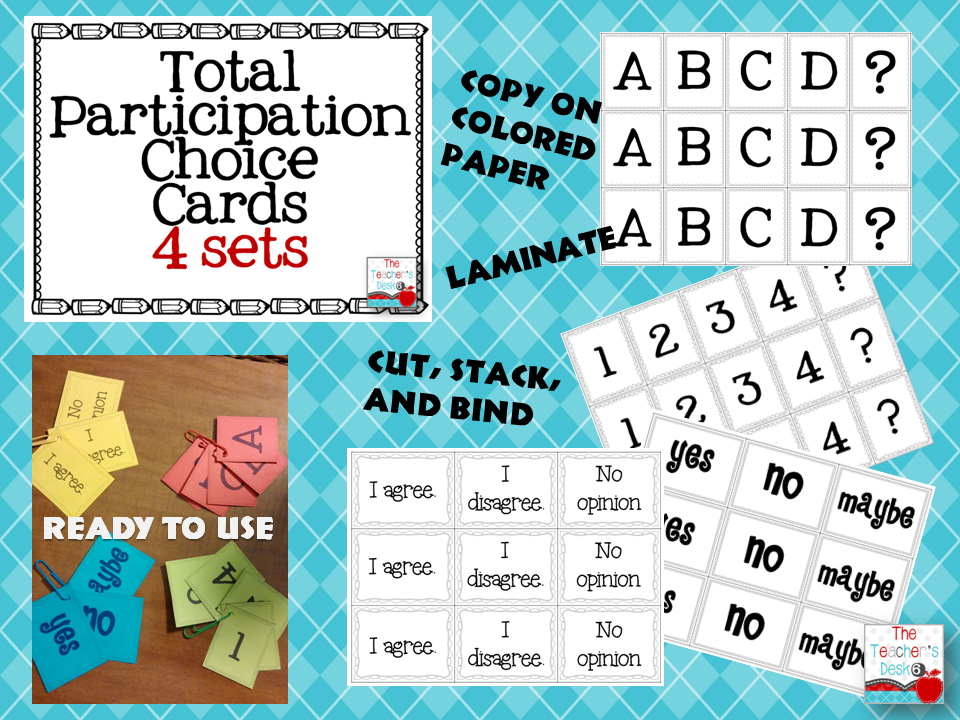
As I read through all the techniques, I decided to implement a few in my instruction this coming year. I have to select just a FEW to not overwhelm myself. Too many and I will forget what is what! Total Participation Cards referred to as HOLD-UPS (there's a HUGE variety mentioned in the book) are something so close to what I'm doing already that I knew I could implement them well. I made two sets: Mastery Cards and Choice Cards.

Mastery Cards are meant to be used by students while they are working. Students select the level of understanding where they are during discussions and work sessions to inform the teacher who then can concentrate on those who are "still working at it." Simple to make and use, you can grab your forever freebie set HERE.


Choice Cards are designed to engage EVERY student in a discussion or question/answer session. You can grab your set (including four options) of this forever freebie HERE.


Be sure you stop by 4th Grade Frolics to check out OODLES of Monday Made Its. Betcha find something there you just can't resist making!